
In a subtle show of strength to China, the Indian Air Force on Tuesday landed its C-130J Super Hercules transport plane at the world's highest and recently-activated Daulat Beg Oldie airstrip in Ladakh near the Line of Actual Control, the scene of a stand-off with Chinese troops in April.

By weakening Sharif, the corps commanders could have a final say in important matters like relations with India, dealing with Taliban militants, interacting with Americans and once again achieving strategic depth in post-NATO Afghanistan. Which is why they may be behind the unrest in Pakistan led by Imran Khan and Dr Tahirul Qadri, says Shahzad Raza.

'After a strategic pause though, Beijing will revive its policy of slowly creeping towards acquiring sovereignty over the South China Sea.'

Swaraj expressed satisfaction over the agenda of the inaugural dialogue while giving the details of the deliberations.

Defence Minister Manohar Parrikar on Monday mooted the idea of raising an all women battalion and stationing of women on warships besides opening the doors of the National Defence Academy and Sainik schools for them.

'India has ramped up infrastructure on its side, so the Chinese military is finding Indian soldiers in locations where they are not used to seeing an Indian footprint,' points out Harsh V Pant.

Pakistan perceives that if it had declared Gilgit-Baltistan, PoK or both, which are only a part of the territories of J&K, as legitimate provinces of Pakistan it would weaken its case for the entire J&K and lead to legal complications, observes Lieutenant General Syed Ata Hasnain (retd).

Girls in the Kashmir valley hurling defiance at the security forces will detract from the legitimacy of India's response and its standing in the world, says Ajai Shukla.

'Ajit Doval has done a splendid job in handling the Pathankot attack and certainly helped save heavy destruction of critical air force assets,' says Abhay Jere.

'We don't know what the reasons were that we gave back the Haji Pir Pass which was strategically very important. Today the entire infiltration into Kashmir takes place from that area. If we had retained that post that we had captured, things could have been different.' 'A lesson we need to learn is if you start losing the gains of war at the negotiating table, they become a disincentive for future wars,' says Lieutenant General D B Shekatkar (retd), reviewing the lessons from the 1965 War.
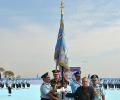
Cautioning against various threats facing the subcontinent, President Pranab Mukherjee on Friday said it was imperative for India to have an effective deterrence and strong defence to promote development and it must be prepared to use its "might" if the need arises.

If the initial analysis of this YJ-21 is correct, then China becomes the first country in the world to operationally field such a missile from a naval vessel.

'What we are actually missing in India is a platform wherein the government engages with cybersecurity experts, gets them employed and then utilises their capability to deter such attacks.'

'Pakistan's security establishment, despite its appallingly immoral approach to conflict, has worked with limited resources to maximise its national defence resources to continue bleeding India,' says Ajai Shukla.
All Indian prime ministers must know that the route to their Nobel Peace Prize doesn't go through Pakistan, says Rajeev Sharma.
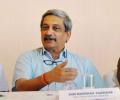
Instead of ramming through change, Mr Parrikar has tied his own hands by placing reform at the mercy of numerous committees, says Ajai Shukla.

The allocation in the defence budget is inadequate to meet India's long-term threats, especially from China and Pakistan, says Gurmeet Kanwal.
China also hinted that India was objecting to its efforts to build the road in Donglang area of the Sikkim sector on behalf of Bhutan.

The Afghan deputy foreign minister explains how his nation's President became disillusioned with Pakistan. Ajai Shukla listens in.

UAVs are an intrinsic part of today's technology driven battlefield. Indians don't seem to be taking the challenge with the degree of urgency that is required, says Brigadier S K Chatterji (retd).
'India appears to have stood its ground on strategic autonomy by resisting US pressure on Russia, China and Iran, but succumbed to the temptation to walk into a tighter embrace in defence cooperation, a high priority of the Trump administration,' notes Ambassador T P Sreenivasan.
'Imran cannot escape responsibility for providing a mask to the Pakistan army to engage in unlawful activities and to wage aggression after India retaliated to the terrorist attack,' says Ambassador T P Sreenivasan.

'Omar Khorsani has called repeatedly for the most barbaric of attacks. He is very adept on social media. He is, in other words, eerily similar to the ISIS leader Baghdadi.' 'The crux of the army's 'strategic asset' policy -- its policy of regarding militants as those that can help Pakistan pursue its regional interests -- is that Pakistan needs help in weakening India or in keeping its presence minimal in the region.' Michael Kugelman reveals what the world can expect next from the Tehreek-e-Taliban Pakistan, the terrorists responsible for the Peshawar school massacre.

Xi, the General Secretary of the Communist Party of China, called the progress China had made under his watch "truly remarkable
Amongst those who heard the message of the Bihar results would be Defence Minister Manohar Parrikar, whose realm is simultaneously the country's most complex and -- when something goes wrong -- the most emotive, says Ajai Shukla.

Though dubbed as the 'war hero', the role of Rajapaksa in ending the conflict with the LTTE with the death of its supremo Velupillai Prabhakaran in 2009 is quite divisive as he stands accused of violating human rights, a charge he vehemently denies.
The National Democratic Alliance government has adopted half measures instead of moving decisively on defence.
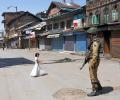
We must repeal AFSPA to begin to heal Kashmir, and to enhance India's moral stature and that of the army, says Ajai Shukla

From Sri Lanka's most popular political family to its most despised -- going by the voices on the streets calling for the Rajapaksas' ouster -- what went wrong for the clan? Veteran Sri Lanka watcher N Sathiya Moorthy offers an insight.

India and China met and spoke a lot this year, but failed to produce any meaningful results.
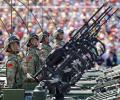
'Whether it is the One Belt One Road project or building relationships in the Indian Ocean Region -- supposedly our area of concern -- the Chinese are seriously outpacing us,' points out Vice-Admiral Premvir Das (retd).

'The accusation that Pakistan risks losing sovereignty to China is emotive and has the potential to spread.' 'China will, however, remain intent on achieving its strategic ambitions of acquiring Gwadar port and securing a large chunk of Pakistan occupied Kashmir,' says former RA&W officer Jayadeva Ranade.

'Ensuring through diplomatic means and in conjunction with strategic partners that India will not be required to fight a simultaneous two-front war with China and Pakistan.' Brigadier Gurmeet Kanwal (retd) lists what India must have in its national security strategy.

'Pakistan's military leaders have to accept that the policy of proxy wars has damaged Pakistan more than it has damaged the enemy,' says former R&AW chief Vikram Sood.
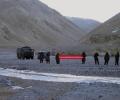
'Demchock and Chumar are important crucibles for both China and India to know about the other. While India 'learns,' she also need to 'teach,' suggests Lieutenant General Anil Chait, one of the Indian Army's most cerebral thinkers, who recently retired as chief of the Integrated Defence Staff.
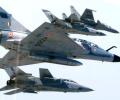
'We could quibble with each other whether there were 25 terrorists killed or 250 killed.' 'The message is more that India undertook such an aerial attack and this attack has actually changed the paradigm.' 'The change in paradigm is that India has shown by the surgical strike in 2016 and the aerial strike of 2019 that we will not just sit back and tolerate terrorism which killed so many of our people.' 'We will hit back and by hitting back we will raise the costs of such activities.'

What was the need for Xi Jinping, general secretary of the Chinese Communist Party, President of the People's Republic of China and Chairman, Central Military Commission, to don the new role of Commander in-Chief? Does this mean that the most powerful Chinese leader since Mao faces numerous threats from within the Communist Party?

The briefing comes ahead of the parliament session beginning Monday.
'We should not minimise the seriousness of Chinese encroachments because their perception is different.' 'Nor should we fall into the trap of accepting so-called 'buffer zones' in areas of overlapping claims. We cannot have buffer zones in our own territory,' asserts Ambassador Shyam Saran, a former foreign secretary.

In the case of India, there are no specific references in China's white paper. However, there are several takeaways for India, says Srikanth Kondapalli.
 © 2026 Rediff.com - Advertise with us - Disclaimer - Privacy Policy - Sitemap - Feedback - About us - Terms of use - Grievances